
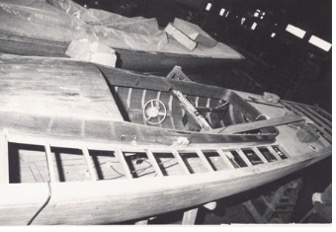
McGruer were the first yard to build Dragons in the 1930s; indeed, UK Dragon number 1 Ta-Yen was built by them in 1938 for Mr ASL Young. However, by one of those quirks that are now lost to the mists of time, the yard had already built numbers 2 to 7 and 9 to 11 in 1936! The last Dragon we know of built by them was Bintyra (K239) for Mr JM Miller & Mr D Moffat in 1951.
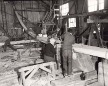
The McGruers moved from Tighnabruaich to Hattonburn at Clynder in 1914 to establish themselves for the first time in their own yard. Having access to powered hand tools slung from overhead cables must have made the work less arduous and uncomfortable. One of the most useful tools was a spindle cutter set in a workbench, on which planks could be cut out conform to a pattern. This was operational when the yard started to build Dragons. They would cut complete sets of planks for a Dragon, three copies of each plank, so that they were always left with patterns for the next boat. The hulls were planked up on standard moulds, an early version of mass production. Although innovative, McGruers did not try building boats upside down, which is much easier than right way up. Shadow moulds would be set up in traditional fashion, the hulls planked up, then the stringers and any steamed frames put in. Old-growth pitch pine, which is excellent for hull planking, was imported from Canada up to 1939, when supplies stopped during WW II and did not resume thereafter. Enormous teak and mahogany logs, up to four feet square, would arrive by sea and would be rendered into workable boards at Gilmour & Aitken’s yard in Jamestown.
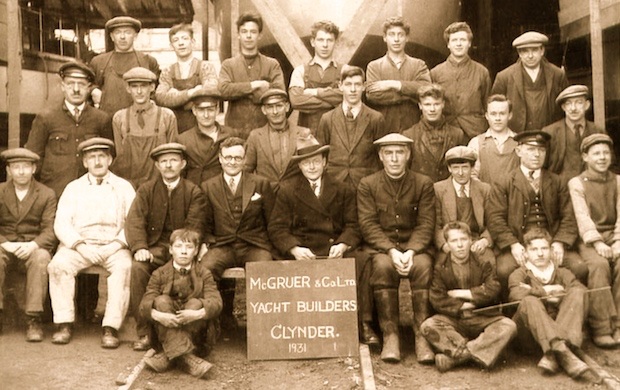
Around the time the boats were built the workforce would have numbered about thirty permanent workers, local residents and usually the family of older employees. In spring local painters and labourers would swell the ranks to deal with fitting out the fleet of racing and cruising boats that wintered at the yard. Many of these were paid hands on the yachts. Although conditions must have been hard, working through the winter in sheds only partly protected from the weather, the workforce is reputed to have been extremely happy. When a boat was reaching an interesting stage everyone would be desperate to get in to work in the morning. Of course at the same time ship-building in the Clyde yards was going on entirely in the open, so perhaps McGruer’s men felt themselves lucky. Both types of activity involved exciting creative work which sometimes had to substitute for proper pay. McGruers’ workforce could also reflect that they worked for one of the best-known yards and even in bad times there would be a reasonable order-book and job security for the permanent employees at least. At one of the smaller yards in the area it was not uncommon for there to be no wages at the end of the week and the local publican had to offer an informal banking service. When the original company finally went into liquidation at the end of 2001, having not built any new wooden boats for about ten years, they were the last of the famous Scottish yards to shut down. (That company is not to be confused with a new company of the same name, which carries on surveying and other services.)
| Country | UK |
| Locations | Clynder, Scotland |
| Years in Operation | 1936-1951 |
| Boats Built | CAN 46 GBR 1 2 3 4 5 7 9 10 11 17 19 21 22 23 25 32 37 39 75 76 87 89 90 91 92 93 94 95 96(USA78) 110 113 114 115 117 118 121 125 128 131(CAN46) 208(USA315) 209(USA177) 221 239 USA 45 78 177 315 |